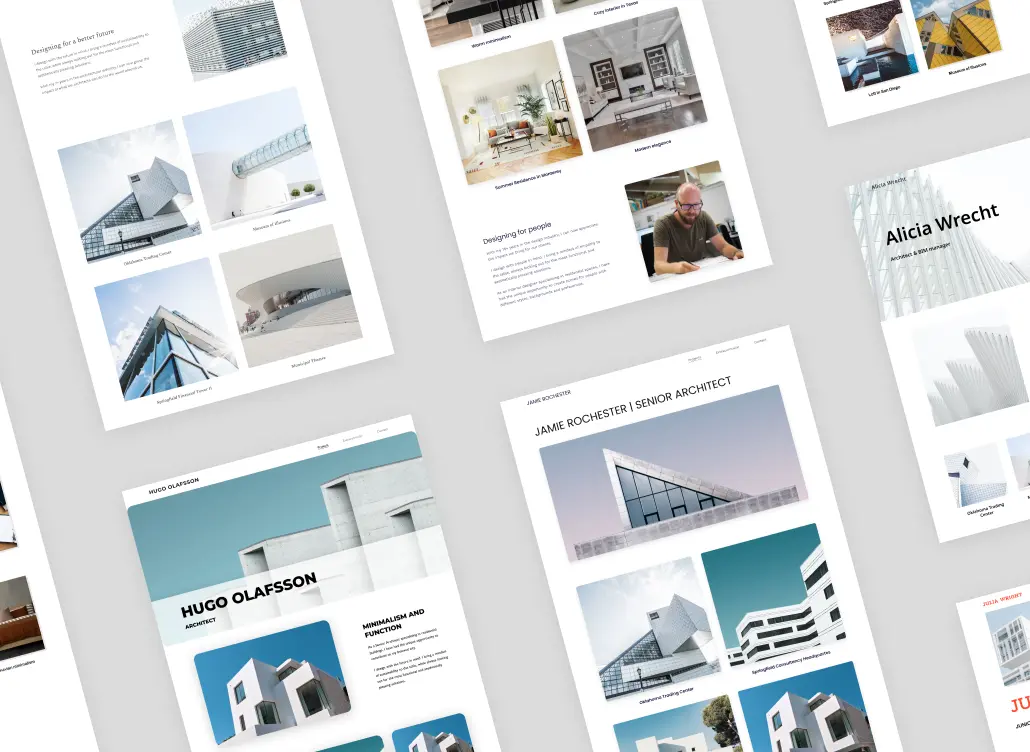
Content Marketing for Architects: Ideas for You or Your Firm

Most architects tend to get new clients via referrals, but you can’t really just sit around waiting for them to come, especially in slower seasons. What you can do is start working on your content marketing to draw potential clients in, even when no one from your network is actively recommending you.
If this post is not the first place you’ve turned to for guidance, you might have seen a bunch of generic steps and dry guides that don’t actually help much. Well, in this guide we’ll give you an easy-to-follow strategy, as well as examples and specific ideas for architecture content you can create.
We separated it into sections for individual architects looking for freelance clients (either full-time or on the side) and for architecture firms, as their content should be vastly different. Read until the end, as we’ll recommend our favorite tools for creating content as architects, including an architecture portfolio website builder tool.
Architects’ go-to content marketing strategy
Whether you’re a freelance architect or a design studio, the general process and steps will be the same. Let’s start with that, so you know roughly what to expect.
1. Research who you’re talking to
Aka find and get to know your target audience. This is basically marketing 101: figure out who your ideal client is, and learn where they hang out online, what their biggest pain points are, and what kind of content they prefer.
As a freelance architect, this will probably be people with smaller-scale projects you could complete alone. As an architecture studio, it’s individuals or other companies looking to start the type and size of building design and construction projects your firm specializes in.
To learn more about them, you can of course do a little research online, but the most valuable action would be to actually talk to them. So reach out to previous clients or connect with some people on LinkedIn, and try to organize a 20-minute call to ask them about it.
2. Choose your platforms (and be realistic)
When you have an idea about what they do online and where (e.g. search for and read blog posts, debate on Reddit, scroll LinkedIn), pick which platforms you want to be on.
And this is where you need to be realistic with yourself. Unless you want to outsource your content marketing, you should pick one or two platform max, ideally ones where you can repurpose the same content.
Because don’t forget: you’re still a working architect and not a content marketer. And although promoting your business is inevitable, it will eat into either your working hours or freetime, so just don’t bite more than you can chew.
3. Plan upcoming pieces of content
At this point you know where you’ll post and who you’re talking to, so the next step is the plan the actual content. Depending on how extra you want to be, there are two ways you could do this.
Go above and beyond: create a system
This requires more time upfront, and for you to be more organized, but it could make your content creating process easier in the long run.
For this, you basically need to create a system, namely content pillars that’ll structure your overall content. Content pillars sound complex, but they are essentially themes or bigger topics, around which your specific content can be built.
You can even assign them days: content around your specific niche on Monday, behind-the-scenes on Wednesday, and project showcase on Friday.
With this in place, later you can just sit down and fill out the gap each week with less brainstorming involved.
The quick and easy: braindump and create
If that sounds like too much work (or you are simply just a little too type B), you can just open up your notes app (or get a piece of paper if you are old school like me). Take 10 minutes and do a content braindump, writing down every single topic idea you can think of.
Topics could be related to your professional life, your niche, your work, your past projects, projects you hope to get someday… The sky is the limit, really.
At this point don’t judge them, just crank write them all down until there is nothing but tumbleweeds left floating around in your brain.
Only then should you do another round, where you go through your ideas and cross out ones that are either not realistic to do or which your actual target audience probably wouldn’t find interesting or valuable.

4. Bulk-create said content
Armed with your list of content ideas (hop over to the next section if you couldn’t come up with any), it’s time to actually make them happen. Our best tip for that is to schedule time and create them in bulk, if you can.
Depending on the format you choose, take a couple of hours of even a day, start going through your list, and get to work. Write the blog posts. Record the videos. Type out your posts and find your images.
This way you’ll never find yourself “needing to post but not having anything”. See how much content you can create at once (a week? A month?) and schedule a session every so often, so you can stay on top of it.
Because the key to successful content marketing, for architects and everyone else for that matter, if consistency. If you start posting but then fall off the face of the earth, that won’t take you very far.
5. Schedule or publish
With everything prepped, all that is left to do is actually putting it out there. Depending on the platform(s) you picked and your workflow, you can either schedule them ahead of time, or set a reminder, and publish them as you go.
Don’t forget to celebrate the first piece of content you publish, the hardest part is getting started, after all.
+1. Check your stats to see what works best
If marketing 101 is knowing your target audience, the next most important thing is measuring the performance of your activities. It happens that you choose a channel or have an idea that doesn’t work out. But you need to know if that is the case, so you can pivot.
Starting any channel from scratch would be hard, so you need to give them time, of course. But if you see after 3-6 months that your posts get no traction and you are getting no leads, then it might be time to go back to the drawing board and switch it up.
Content marketing ideas for individual architects
As a freelance architect, looking for new clients either full-time or on the side, your target audience will be people looking to do smaller projects, or to outsource parts of the design project, that a single architect can handle. Narrow that down by your location and specialization, to get the perfect fit.
But the question is: what kind of content can you create that will help them find you and convince them to hire you? Here are some ideas.
Write a blog on professional but niche topics
Especially if you’re specialized in something specific, getting clients to find you through blog posts covering different details of that niche is one of the best things you can do.
Think of all the questions that are not self-explanatory, even if someone knows a little bit about architecture. Things clients tend to ask, concepts you find yourself explaining again and again.
You can write them out as individual blog posts, even in a sort of question-and-answer format. It’s not only easy to skim and read for clients, but Google and LLMs will love it too. So don’t worry about making each post long and thorough: in your case it’s better to publish shorter pieces but more frequently.
While creating an Instagram account or YouTube channel sounds easy, making a blog could seem like a bigger task at first, especially as an architect. But the good news is that if you made your architecture portfolio with Archifolio, all you have to do it add a new section, to start blogging.
Archifolio has a dedicated blog section with a what-you-see-is-what-you-get editor, where you can write or paste your text in to schedule or publish blog posts easily. You can add it anywhere on your portfolio website, though we recommend creating a dedicated page for it.
It’s free to try, so why not give it a go?
Record an architect’s house tour
Meaning a tour of your own house, or ones you’ve designed. People love seeing finished spaces, as it gives them an idea of your architectural design style, skills, and the type of projects you typically do.
A video can also show all the details way better than pictures, and makes it easier for you to explain the thoughts and reasons behind certain decisions.
Consider making this a series on Instagram or Youtube, depending on which platform you chose after your initial research. (And how much you like to talk. We recommend YouTube for longer, more thorough videos, and Instagram for bite sizes, faster-paced content.)
Redesign other people’s spaces
Credit goes to Daniel Titchener for this concept.
The idea is to take someone’s space, even remotely, and redesign it based on the struggles they have. You can explain your whole design process, which shows potential clients how you think, and also display the finished results (aka your 3D renders) to demonstrate both your vision and 3D visualization skills.
You can make it into a blog post, LinkedIn post with an image carousel, YouTube video, or short-form social media video depending on your platform(s), but we recommend YouTube for the best results.
Content on things to consider before building a new house
Thinking about content that could be both interesting and helpful for potential clients, you can talk about things to consider before building a new house. This one’s for people who are at the very beginning of the process, which might also be when they choose their future architect.
This will not only help them find you, but also show them your expertise through the things you typically only learn by experience. Make sure to emphasize how you know all these, to position yourself as an insider and expert at the same time.
You can do this via blog posts or LinkedIn posts as sort of a series, but you can also create videos if you don’t mind being on camera and can get not-stock-looking, quality B-roll for it.
B-roll is the type of footage that illustrates what you’re talking about, providing an interesting background while you’re explaining the main concepts. Think of shots like people walking around an empty lot before building, videos of construction, clients and an architect talking, going over printed floor plans and other technical drawings.
Content marketing ideas for architecture firms
Unfortunately just like the advice out there, content made by architecture firms tend to be on the dry-and-boring side (sorry not sorry). They forget is that the potential clients, even if they’re other businesses, are also humans after all.
It’s a real person looking for the design studios to invite to a tender or hire for the project. And if they’re on the brink of falling asleep when reading through your site or posts, that’s definitely not increasing your chances of being memorable for them.
Sure, an impressive track record and convincing portfolio are the most important, but why not add a sprinkle of humanity (and a little pizzazz) to your content to stand out?
Introduce your colleagues and staff
Going back to the “it’s humans who hire your firm and humans they will be working with” idea, consider introducing your colleagues. Both the ones clients might actually get to work with (for obvious reasons) and the ones who work more behind the scenes, in admin, finance, and more, to show your company culture and your firm’s human side.
Format-wise, you could do short videos for Instagram or LinkedIn, introducing one person at a time, or longer ones for YouTube with 2-3 people in each, which you can even embed on your website.
You could also do a tour of your studio with someone from the team introducing everything, as you can see here:
Technically, you could write blog posts as well, but treads a little too close to the boring corporate content territory, so if possible, skip that route this time.
Answer typical client questions
This content idea could help you both draw clients in and also save time with back and forth emailing.
For this, sit down with your team, and ask them what questions they tend to get from clients again and again. Write a long list and get them to write down the answers too, sort of like an ultimate architecture FAQ that’s unique to your design studio’s work.
You can then turn each piece of question-and-answer combo into a unique piece of content. You could do short-form videos (think LinkedIn, Instagram, or YouTube shorts), YouTube videos with 2-3 questions, or even blog or social media posts with some nice, on-brand visuals.
If LinkedIn is one of the channels you chose, we recommend doing LinkedIn videos with properly written captions, as they’re great for SEO too, these days.
If you can, ask colleagues to interact with the posts as they get published, as even Google might rank LinkedIn content that gets a lot of traction.
Tour finished projects
Similarly to solo architects, showing finished buildings and completed designs can be really powerful when trying to land new clients. It’s very visual and easy for them to “consume” and can showcase the expertise of your firm well.
For maximum impact, you should do it in a video format, ideally with one person filming, and another one taking a tour on site, explaining not just what’s seen, but also why it was designed that way.
The best platform for this type of content would be YouTube, but you can definitely try shorter versions on LinkedIn and Instagram as well.
If nobody from the team wants to do talk-throughs, you could even record a video like this:
Feel free to check other videos on UNS’s channel too, they’re doing a great job at showcasing their work, expertise, and company culture as well.
Tools to create content as an architect
Having ideas on what to create is a great first step, but eventually you’ll have to actually make them happen too. So here are our top tool recommendations for architects ready to jump into content creation.
Content planning

It’s good to have a space to not only write out your ideas but to also keep everything organized. Our current recommendation for that is Notion.
In Notion, you can create pages like in a notebook, but then have multiple different formats on them: notes, simple tables, more complex databases, embeds, and more.
We specifically recommend you to create a new database for all your content marketing, with a separate entry for each idea. You can then add properties like status, topic, platform and such, and write out the idea or script in the notes part of the entry page.
Video editing

For editing your videos, we have two recommendations.
If one of your chosen marketing platforms is Instagram, then go with Edits.
Edits is made by Instagram, it’s free to use, and makes it really easy to post your finished video. Some assume the algorithm will even give it a little boost if you post via Edits. The app is also really intuitive and easy to use, so we highly recommend.
If you’re looking for something outside of the Meta ecosystem, you can try Capcut.
Capcut has a free version, both a mobile and desktop app, and loads of music, sound effects, and animation options for you to try. It can be annoying when you bump into its paywall, but you can totally get away with using the basic features, especially at the beginning.
Photo editing

Our favorite for photo editing is still the good old Adobe Lightroom.
Especially if you’re used to Adobe apps from using InDesign, using it will be pretty easy, and even quite fun. You can find and use presets if you don’t want to fiddle around with the detailed settings, and connect with others through their community features.
Lightroom of course also has some AI-assisted editing features, that can save you lots of time by selecting your subject, or just the sky, so you can adjust them separately.
If you don’t have a Creative Cloud subscription yet and don’t want to pay the full desktop price, we recommend you to check their mobile subscription, which you can then use both on your phone and tablet to edit your photos.
Creating visuals

Staying within the Adobe ecosystem, if you already know and love these apps, you can definitely create your visuals with InDesign or Photoshop. Or if you don’t have a subscription and are looking for a very similar but free alternative, you can check out the browser-based PhotoPea.
But if you need templates and lots and lots of inspiration, go for Canva instead. Just be careful not to end up with a too Canva-template-looking post, and also be mindful of the Premium elements, for which you’ll have to subscribe.
Blogging & portfolio building

Last, but most certainly not least, your best choice for blogging and building your portfolio as an architect, is Archifolio.
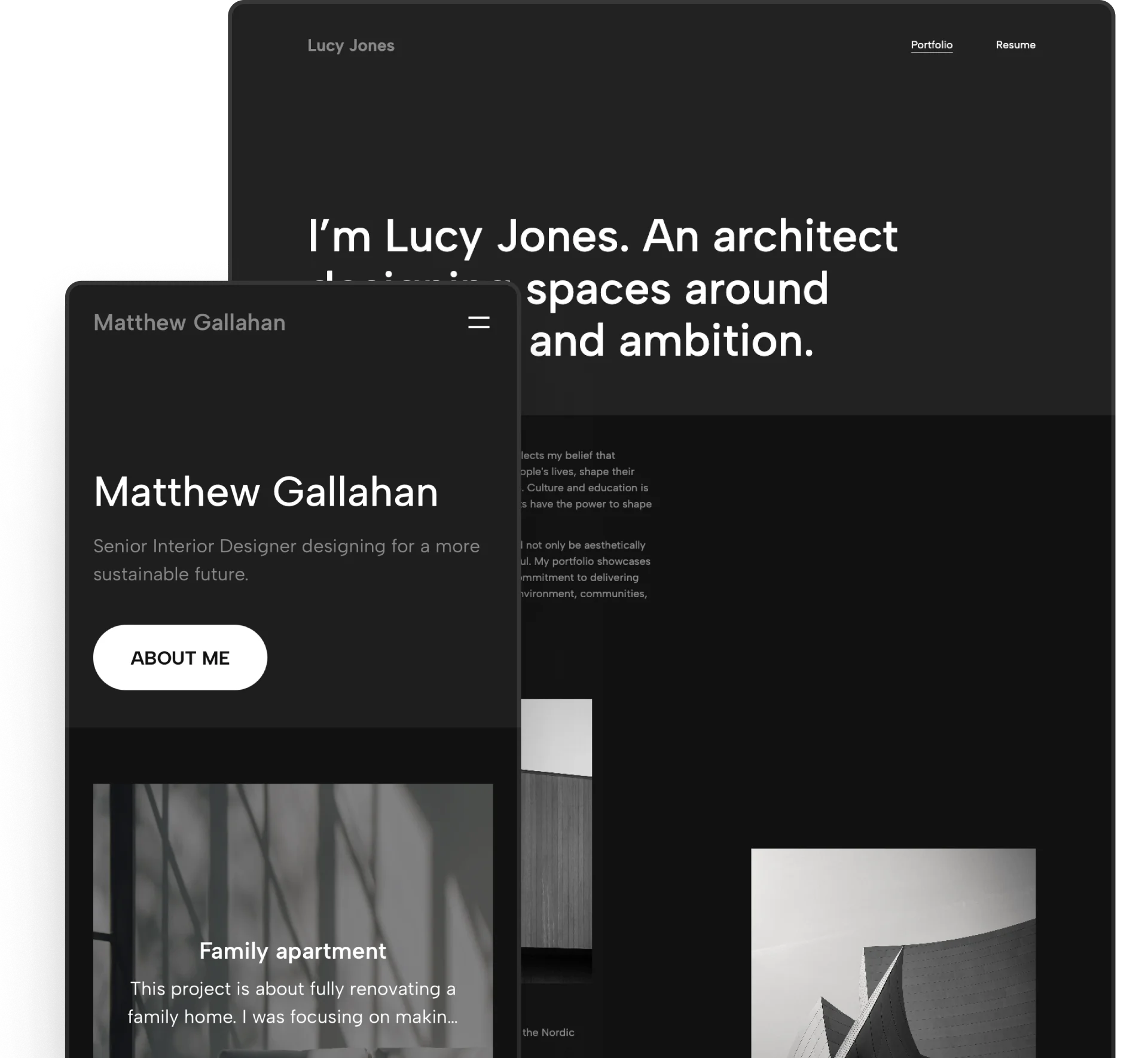
Archifolio is a portfolio website builder made for architects and interior designers, which not only lets you export your website into a PDF, but also has an intuitive blogging feature. This means you can showcase your architecture work on one page, and write a blog to drive traffic to it and get leads on another.
If you already have your portfolio as a PDF, you can simply import it, and Archifolio will generate a website for you, adding all your projects and images, ready to go. All you have to do then is add your blog page and section, and you can start creating content right away.